
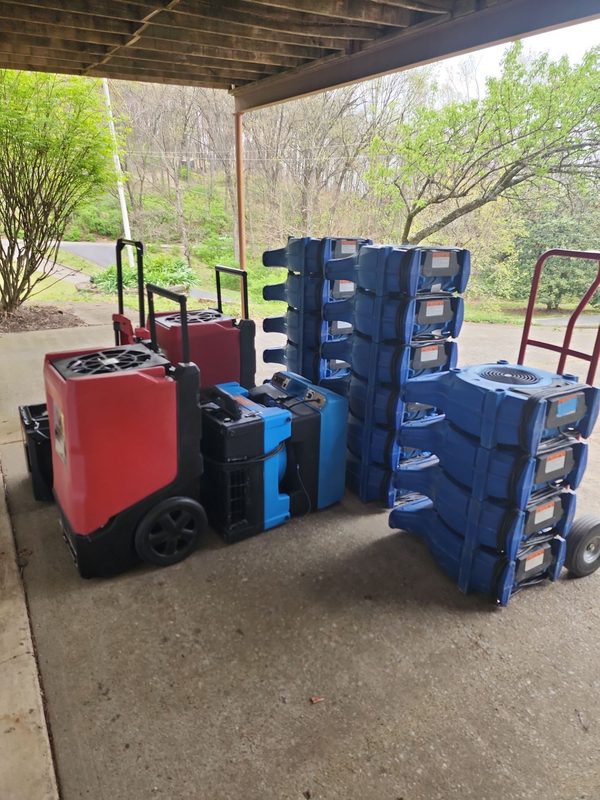
Basement sewer backups are the single most emotionally rough loss we run. It is not just the volume of water; it is the fact that the water contains sewage, and it is in the room where the kids play. This guide walks through why Portland basements back up, why IICRC S500 classifies sewage as Category 3 water, what proper cleanup looks like, and how to add insurance coverage before the next event.
Why Portland basements back up in winter
Large parts of inner Portland still use combined sewers (stormwater and sewage share the same pipe). During a heavy atmospheric river event, storm flow overwhelms the system, pressure builds, and the lowest fixture in the neighborhood becomes the relief valve. That is usually a basement floor drain, laundry standpipe, or utility sink.
The second common cause is a clogged private lateral: the pipe from your house to the city main. In neighborhoods like SE Portland, St. Johns, and older Vancouver WA blocks, those laterals are frequently original 1900 to 1940s clay tile. Douglas fir and cedar roots find the joints, and a slow blockage becomes a sudden backup.
Category 3 water: why sewage is treated differently
IICRC S500 classifies sewer water as Category 3 (grossly contaminated). It contains bacteria, viruses, protozoa, and industrial chemicals. Any porous material it touched (drywall, insulation, carpet, pad, particleboard cabinets, upholstered furniture) has to be removed. Structural framing that stays gets antimicrobial treatment and moisture verification before anything is rebuilt.
This is not a DIY job. Beyond the health risk, doing the cleanup without documentation and industry-standard protocols usually voids any insurance coverage available for the loss.
What professional sewage cleanup looks like
- Full personal protective equipment for every technician on site.
- Isolation of the affected area with containment and negative air with HEPA filtration.
- Extraction of all standing water and physical sewage debris.
- Removal and disposal of all Category 3 impacted porous materials.
- EPA-registered antimicrobial application to remaining structural surfaces.
- Documented drying to the S500 dry standard with daily moisture logs.
- Post-remediation verification before rebuild starts.
What insurance actually pays
Standard Oregon and Washington homeowner policies exclude sewer and drain backups unless you carry a specific sewer backup endorsement. Coverage limits on that endorsement range from $5,000 to $25,000 depending on carrier. If you own a Portland home with a finished basement, ask your agent (PEMCO, Country Financial, Farmers, State Farm) specifically about a higher sewer backup limit at your next renewal. Annual cost is usually under $75.
Where the city sewer main itself failed and caused the backup, the Portland Bureau of Environmental Services has a claim process for property damage. Document everything, keep every receipt, and file promptly.
Prevention that actually works
- Install a backwater valve on your main lateral if you have a finished basement.
- Schedule a lateral camera inspection every 3 to 5 years for pre-1960 homes.
- Keep floor drains and laundry standpipes clear and add rubber standpipe caps.
- Never pour cooking grease down any drain.
- Watch flushable wipes carefully. They do not break down and are a top cause of lateral blockages.
Why DIY sewage cleanup is a bad idea
Sewage exposure carries real bacterial, viral, and parasitic infection risk (E. coli, hepatitis A, giardia, cryptosporidium, and more). Even with gloves and a mop, you are almost certainly cross-contaminating clean parts of the house and inhaling aerosolized pathogens without containment. Insurance carriers also expect professional documentation for any Category 3 loss; DIY cleanup usually voids the little coverage that is available.
How the Portland BES claim process works when the city main failed
If the backup was caused by a failure of the public sewer main (not your private lateral), the Portland Bureau of Environmental Services has a written claim process. Document immediately, keep every receipt, and file promptly. Approval depends on whether the failure was inside the city's maintenance responsibility.
Sewage backup in your Portland basement? 24/7 IICRC S500 Category 3 response.
Call (503) 883-8429