
Most newcomers assume Portland does not really flood, it just rains a lot. Longtime residents know better. Every winter, plumes of subtropical moisture (atmospheric rivers, sometimes called the Pineapple Express) push into the Pacific Northwest and stall against the Coast Range and Cascades. A single event can deliver three to six inches of rain in 24 hours, saturating clay soils and pushing water into the same basements, garages, and crawl spaces every year.
This guide is the practical version: where the Portland metro actually floods, what to do before the season, how to act in the first hour after water gets in, and what your insurance does and does not cover. It is written for homeowners in Sellwood, St. Johns, SE Portland, Lents, Gresham, Vancouver WA, and anywhere else that sits near Johnson Creek, the Columbia Slough, or a low spot in the grade.
Why Portland floods when the Pineapple Express arrives
Between roughly November and March, plumes of subtropical moisture (atmospheric rivers, sometimes called the Pineapple Express) push into the Pacific Northwest and stall against the Coast Range and Cascades. A single storm can deliver three to six inches of rain across the Willamette Valley in 24 hours, saturating clay soils that no longer accept water, then running toward the Willamette, Columbia Slough, and Johnson Creek.
Portland has a mixed storm and combined sewer system that handles most events, but when a river event coincides with saturated ground and a king tide on the Willamette, the tail of the bell curve puts water into the same basements, garages, and crawl spaces every winter.
Where Portland floods most
Our crews see repeat flooding in the same neighborhoods every season. If you live in one of these areas, treat winter prep as non-optional.
- Sellwood, Westmoreland, and Brooklyn along the Johnson Creek and Crystal Springs corridor.
- St. Johns, Cathedral Park, and North Portland along the Columbia Slough.
- Southeast Portland basements between Division and Powell where combined sewer surcharge is common.
- Lents and Powellhurst-Gilbert along the lower Johnson Creek floodplain.
- Older sections of NE Portland (Cully, Concordia) with 1920s clay lateral lines and low garages.
- Vancouver WA along Burnt Bridge Creek and low-lying Hazel Dell parcels.
Pre-season prep: a one afternoon checklist
Most winter claims trace back to a handful of preventable conditions. Walk your property in October and you eliminate most realistic risk.
- Clear gutters, downspouts, and roof valleys. Douglas fir needles and big-leaf maple leaves clog every fall.
- Extend downspouts at least six feet from the foundation and confirm the discharge does not pond against the house.
- Test the sump pump and add a battery or water-powered backup if you have a finished basement.
- Check that yard drains and area drains along the sidewalk and driveway are clear of leaves and moss.
- Photograph valuables in garages, basements, and ground-floor rooms so a claim moves faster.
- Move stored cardboard, electronics, and holiday decor off basement and garage floors onto shelving.
What to do in the first hour after water gets in
Speed decides how much the loss costs. Drywall, baseboards, and flooring that sit wet overnight usually have to come out. The same materials addressed inside two hours often dry in place.
- Cut power to any circuit where water is touching outlets, lights, or appliances.
- Move wet contents to a dry area to keep dye transfer off carpet and pad.
- Photograph and video everything before you move or clean anything.
- Call your insurance carrier and a 24/7 IICRC certified restoration company at the same time.
- If the source is still active (a clogged downspout, a backed up area drain, a sewer surcharge), divert it before extraction starts.
What insurance covers and what it does not
This is where many Portland homeowners get a hard surprise. Standard homeowner policies cover sudden internal water damage like a burst pipe, but they exclude surface water and rising water that comes in from outside. That includes atmospheric river runoff entering through a garage door, sliding door track, low window well, or basement stairwell.
Coverage for surface flooding requires a separate flood policy through the National Flood Insurance Program (NFIP) or a private flood insurer. If your home sits near Johnson Creek, the Columbia Slough, Fanno Creek, or any low spot in East Portland, look up your flood zone on the FEMA Flood Map Service Center and price a policy. Annual premium is often less than a single restoration deductible.
Why fast drying matters in the Pacific Northwest
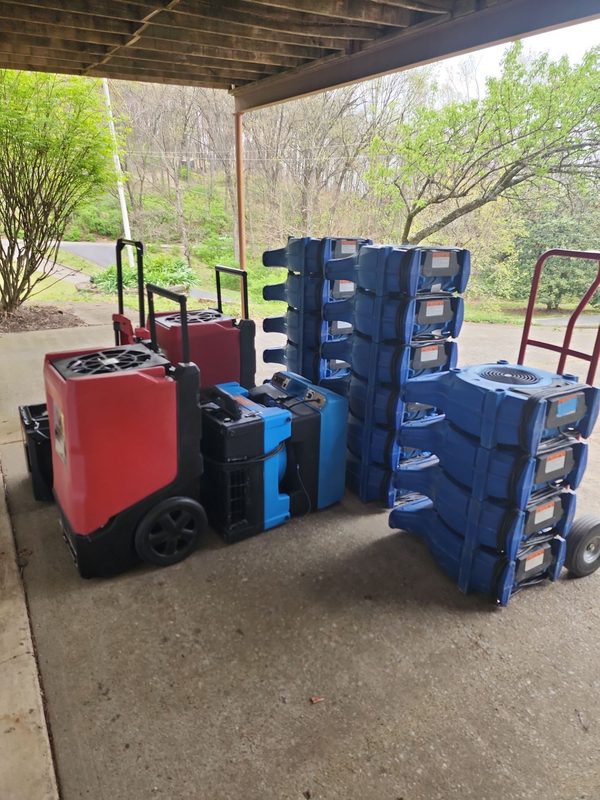
Portland winter humidity typically sits at 80 to 95 percent, which is the opposite of favorable drying conditions. Without commercial dehumidifiers running on day one, mold colonies can begin inside drywall cavities within 24 to 48 hours. Opening windows does not help; outdoor air is often as wet as indoor air during a river event.
How Portland's combined sewer system works (and where it does not)
Portland has invested over a billion dollars in the Big Pipe project and related upgrades, dramatically reducing combined sewer overflows into the Willamette. The system is sized for a design storm, though. When an atmospheric river drops the design storm's water in half the time, the system surcharges. Water finds the lowest fixture in the neighborhood, which is often a basement floor drain or laundry standpipe. The Portland Bureau of Environmental Services publishes real-time CSO status during large events.
What carriers actually pay for after a Portland flood
The dividing line is whether water entered from inside the building (covered) or from outside (excluded). Wind-driven rain that pushed water through a compromised roof into the attic is generally covered. Water that flowed across your driveway into the garage is not, regardless of how heavy the storm was.
If your home has flooded from surface water before, document everything in writing, talk to your agent (PEMCO, Country Financial, Farmers) about a private flood policy, and add a sewer backup endorsement (usually under $75 per year) if you have a finished basement.
The bottom line
Atmospheric river flooding is the most common large insurance loss in the Portland metro, and it is largely predictable. If you live in a known flood-prone neighborhood, prep your home in October, add flood and sewer backup coverage, and save a 24/7 restoration company in your phone before the season starts. The first hour after water gets in decides whether your loss is small or significant.
Flooded after an atmospheric river? Our IICRC certified Portland crews extract, dry, and document for your carrier 24/7.
Call (503) 883-8429