
The Portland ice storm setup is unique: a cold east wind blasts through the Columbia River Gorge at 40 to 70 mph while a warmer Pacific storm slides over the top. Rain falls through the warm layer and freezes on contact with everything at ground level. The result is a glaze of clear ice that coats power lines, tree canopy, and roofs for days.
This guide covers what actually fails during a Portland silver thaw, how to prep with the 48 to 72 hours of lead time the National Weather Service typically gives you, and how to react in the first hour after a pipe splits or a tree hits the house.
Why Portland ice storms are so destructive
The setup is unique to the Willamette Valley: a cold east wind blasts through the Columbia River Gorge at 40 to 70 mph while a warmer Pacific storm slides over the top of that cold air. Rain falls through the warm layer, then freezes on contact with everything at ground level. The result is a glaze of clear ice that coats power lines, tree canopy, and roofs for days at a time.
Douglas fir and big-leaf maple were not built for that load. Limbs and whole trees fail across West Linn, Lake Oswego, the West Hills, and the Cascade foothills. Power stays out for days. Homes with garages plumbed on exterior walls or unheated crawl spaces see supply lines split when temperatures finally drop below freezing overnight.
What actually fails in a Portland ice event
Three loss types account for almost every insurance call we run during and after a silver thaw.
- Trees and heavy limbs on roofs, garages, decks, and vehicles.
- Frozen and split copper or PEX supply lines in cold garages, crawl spaces, and exterior walls.
- Ice dams at eaves on lower-slope roofs, especially where attic insulation is thin.
Prep before the ice arrives
The National Weather Service Portland office usually flags a silver thaw 48 to 72 hours ahead. Use the lead time.
- Open cabinet doors under kitchen and bathroom sinks on exterior walls to let warm air reach supply lines.
- Leave a pencil-thin trickle running from the fixture farthest from the meter.
- Disconnect and drain garden hoses at hose bibs; add insulated bib covers.
- Locate the main water shutoff, label it, and make sure every adult in the house knows where it is.
- Charge phones, headlamps, and any medical devices before the outage arrives.
- Park cars away from big Douglas firs and unhealthy trees you already had concerns about.
First hour after a pipe splits
You almost never hear the split. You hear water. Move fast.
- Shut the main water off at the meter or house shutoff.
- Cut power to any circuit where water is reaching outlets, lights, or appliances.
- Photograph the source and every affected room before moving contents.
- Call your insurance carrier and a 24/7 IICRC certified restoration company at the same time.
- Do not turn the water back on until a plumber has isolated and repaired the split line.
First hour after a tree hits the house
Get everyone out of any room under the impacted section, even if the ceiling looks intact. Call 911 if anyone is hurt or a live power line is involved. Then call your insurer and a restoration company for emergency tarping and board-up. Do not try to remove the tree yourself; live loads on partially failed limbs are how people get killed in the days after an ice storm.
Insurance basics for ice storm losses
Standard Oregon and Washington homeowner policies generally cover sudden tree damage to the structure and interior contents, wind-driven rain damage after a covered opening, and water damage from frozen pipes (as long as heat was reasonably maintained). Tree removal is often covered up to a sub-limit (commonly $500 to $1,500 per tree) when the tree damaged a covered structure. Trees that fell in the yard without hitting anything are usually not covered.
Why the Gorge east wind pattern is uniquely destructive
The Columbia River Gorge is the only sea-level cut through the Cascades. When Arctic air pools in eastern Oregon and a Pacific system approaches from the west, the pressure gradient funnels cold air westbound through the Gorge at freeway speeds. West Linn, Lake Oswego, Corbett, Troutdale, and the West Hills feel it first and hardest. Combine that wind chill with freezing precipitation and you get catastrophic tree loading in hours.
What proper frozen-pipe restoration includes
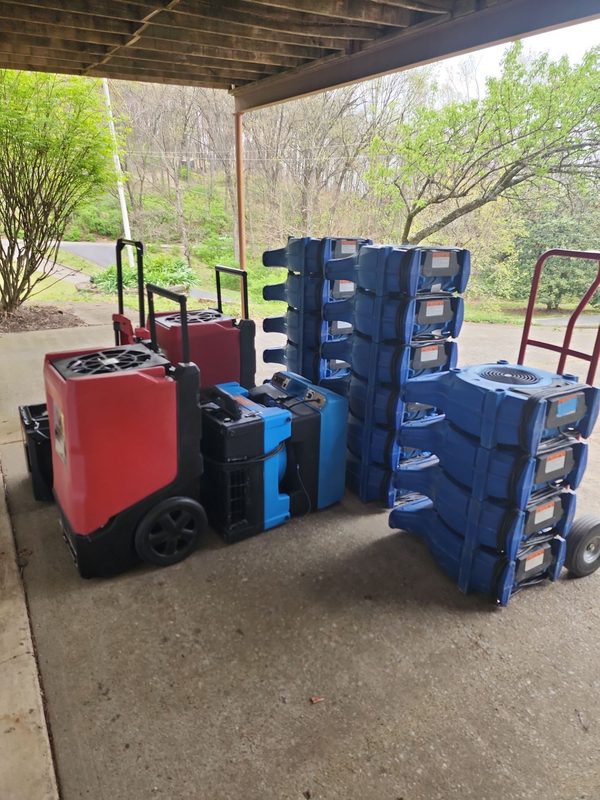
When a supply line splits and floods a room, the restoration sequence matters. Extract water, set drying equipment sized to the affected area, document daily moisture readings for the carrier, remove any Category 2 or 3 impacted porous materials, then coordinate with the plumber so the split is repaired before rebuild starts. Rebuilding before framing is dry to standard is the fastest way to end up with a mold remediation call six months later.
Broken pipe or tree on the roof after a silver thaw? IICRC certified Portland crews respond 24/7.
Call (503) 883-8429